

Installing a pergola or glazing in a coastal location means subjecting materials to one of the most severe environmental stresses: the corrosive action of salt spray. In these contexts, durability is not an abstract concept, but the result of precise engineering choices.
A properly treated aluminum outdoor system is not just a design choice, but a capital protection investment that guarantees a lifespan of over 30 years, reducing maintenance costs by 50% compared to wooden structures.
The secret to longevity: SEASIDE certified pre-treatment
For installations in high-salinity environments, standard aluminum pre-treatment is not enough. For this reason, Sunroom adopts advanced protection protocols right from the raw material, using coating cycles that comply with the strictest international standards for marine environments.
The manufacturing benchmark is the QUALICOAT SEASIDE certification. This protocol provides an enhanced pre-treatment compared to the industrial standard:
- Dual Acid and Alkaline Attack: A deep deoxidation is performed with an aluminum removal equal to 2.0 g/m² (double the 1.0 g/m² of standard treatments).
- Elimination of Impurities: This process removes all traces of pollutants from the metal surface, creating a total barrier that prevents filiform corrosion and keeps the aesthetics unaltered over time.
- Product Certification: Each individual batch is strictly tested for film thickness, adhesion, and coating curing.
Excellence Note: For Central European and French markets, where regulations are even more restrictive, Sunroom systems can comply with the QUALIMARINE supply chain certification (managed by the French body ADAL), which guarantees total traceability and daily chemical checks on the raw material.
Why stainless steel makes the difference on moving components
Carriages, tracks, and screws are the components most exposed to galvanic corrosion. Sunroom exclusively uses stainless steel on all sliding parts.
In coastal environments, the specified grade is AISI 316 – the “marine” alloy par excellence – which, thanks to the presence of molybdenum (2-3%), guarantees a significantly higher resistance to chlorides than the more common AISI 304, eliminating the risk of oxidation over the long term.
Routine maintenance program
Operations are few and easily manageable on your own. What makes the real difference is consistency and frequency.
Cleaning aluminum profiles
- Minimum frequency: 4 times a year. For “front-line” installations (within 500 meters of the sea), it is recommended to increase to 6 times a year (once every two months).
- How to do it: Use lukewarm water and neutral detergent. Absolutely do not use acidic or abrasive products: they would compromise the coating layer, canceling out the effect of the protective SEASIDE treatment.
Sliding carriages and tracks
- The problem: Sand and salt buildup in the lower tracks are the main cause of stiff or noisy sliding.
- How to do it: Remove debris with a brush and a damp cloth, then lubricate exclusively with silicone oil (avoid mineral oils, which attract and retain dust).
- Frequency: At every season change, with an additional inspection after strong sea storms or high-wind days.
- This precaution is essential for all systems, from Sliding Glass Doors to Tuttovetro Systems.
Gutters and water drains
- How to do it: Check that the drain slots integrated into the Bioclimatic Pergolas are completely free of leaves, pine needles, or salt build-up.
- Frequency: At least twice a year (spring and autumn). Stagnant water, combined with salt, accelerates corrosive processes even on protected profiles.
Gaskets
- How to do it: Check flexibility and adhesion to the glass. Treat them every 6-12 months with a silicone lubricant to keep them elastic and prevent them from hardening due to sun and salt.
- Frequency: Twice a year. At the first sign of stiffness or detachment, replacement is preferable to waiting, so as not to compromise thermal insulation and airtightness. This applies to both Folding Glass Doors and Sliding Systems.
Signs not to ignore
- Stiff or noisy sliding: Indicates debris build-up in the tracks or the beginning of bearing wear. Prompt intervention avoids irreparable damage to the guides.
- Whitish stains on profiles: If they resist washing with water and diluted vinegar, it is not simple limescale, but a potential corrosive attack. In this case, it is essential to call a technician.
- Fogged glass internally: Indicates a broken seal in the double glazing. The glass has lost its insulating properties, and replacement needs to be planned.
A real case study: Sopravento Restaurant in Cattolica
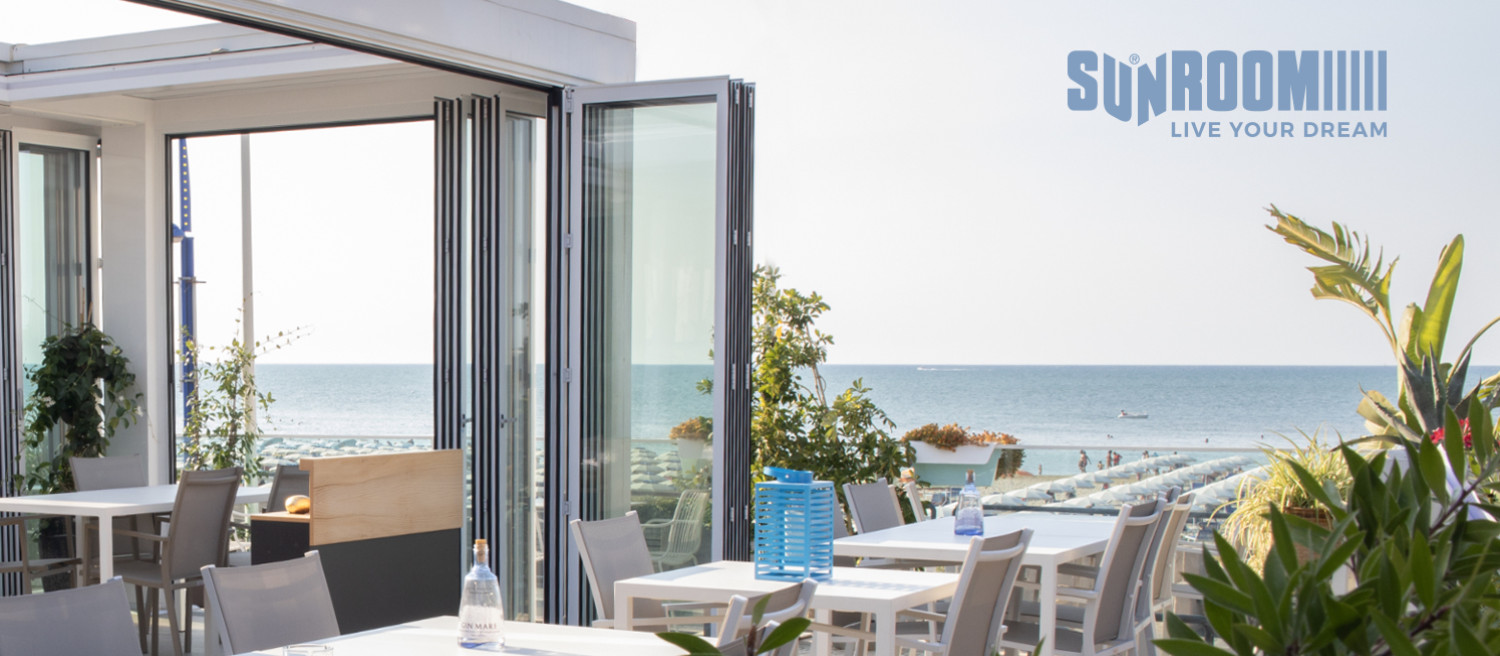
The outdoor area of the Sopravento Restaurant, built under three Oskura XL pergolas with S.60 TT thermal break folding glass doors, represents a tangible technical benchmark for coastal installations.
Constant exposure to Adriatic marine winds required the application of the strict Qualicoat SEASIDE coating protocol. Thanks to this design choice, the structure prevents chloride corrosion without altering the minimal aesthetic impact, allowing the venue to operate 12 months a year without interruptions or expensive structural downtime related to extraordinary maintenance.
Aluminum vs. Wood in coastal areas: a comparison
The comparison concludes with economic and life-cycle data:
| Feature | Sunroom Aluminum (SEASIDE Treatment) | Wood (Even if treated) |
| Useful life in marine areas | Over 30 years | Lower (subject to structural degradation) |
| Extraordinary maintenance | Not required (routine cleaning only) | Repainting and sanding every 1-3 years |
| Life-cycle costs | Standard | Up to 50% more compared to aluminum |
| Sustainability | 100% recyclable (retains residual value) | Complex disposal due to protective coatings |
Annual maintenance calendar
Routine maintenance, if carried out regularly, requires only a few hours a year. Here is the seasonal schedule to follow:
| Season | Operations to carry out |
| Spring | Post-winter inspection: check gaskets and drain slots. Wash profiles. Clean and lubricate carriages and guides. |
| Summer | Wash profiles. Increased track cleaning (higher frequency due to wind-blown sand). Lubricate carriages. |
| Autumn | Wash profiles. Deep cleaning of gutters and rainwater drains. Check and apply protective treatment to gaskets. Lubricate carriages. |
| Winter | Wash profiles. Visual check of the seal and any fogging of the double-glazed units. |
For installations in coastal areas with specific requirements or to schedule a preventive technical check, contact us: our network of qualified Sunroom partners and installers is at your complete disposal.
