

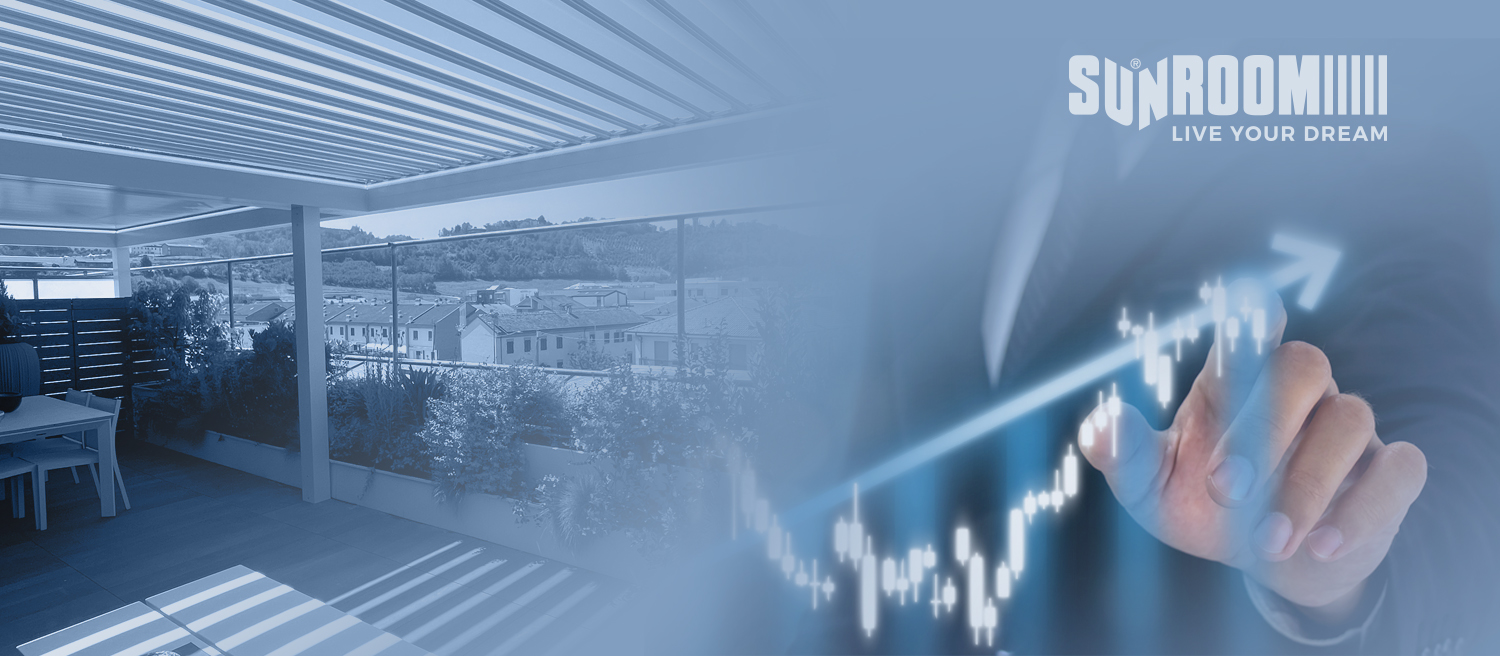
In the contemporary real estate market, a property’s valuation is no longer based exclusively on covered square footage.
The transition toward new living and working models (such as structured remote working) has redefined buyers’ priorities
Today, outdoor space is no longer considered an ornamental accessory, but a vital extension of the home.
Integrating an engineered outdoor solution does not represent a luxury expense, but a precise asset capitalization intervention capable of generating immediate and tangible financial returns.
Market Value Impact: The Numbers of Well-being
The installation of a bioclimatic pergola or a certified solar greenhouse increases the commercial value of a property by 10% to 20%.
With a direct financial ROI estimated between 65% and 85% of the construction cost, Sunroom structures amply pay for themselves at the time of sale, accelerating time on the market by over 30%.
This increase in value is driven by unprecedented demand: real estate searches for homes equipped with livable terraces, gardens, or furnished patios have recorded a steady 35% increase compared to the pre-pandemic period.
For a seller, presenting a property with an already optimized outdoor space means positioning themselves immediately in the premium segment of the market.
Heated Living Space vs. Livable Outdoor Space
From a physical and building bureaucracy standpoint, expanding a house’s internal heated square footage is a complex, expensive process that is often restricted by rigid volumetric limits. Sunroom solutions bypass this obstacle by creating a “fluid surface”:
- Bioclimatic Solar Greenhouses make it possible to obtain bioclimatic technical rooms that do not generate taxable volume for property tax purposes, while offering a thermally protected space that is perfectly livable all year round.
- Dynamic Roofs: Motorized roofing systems like our Motus allow opening up to two-thirds of the roof surface, adapting the environment to the seasons without the need for heavy authorization procedures.
Aluminum vs. Wood: The Bank Appraiser’s Perspective
When a potential buyer applies for a mortgage, the lending institution’s appraiser evaluates not only the current state of the property, but also the future depreciation of the materials.
In this scenario, the choice of materials for outdoor structures is crucial.
A wooden structure, while charming at first, tends to degrade rapidly under the effect of UV rays and bad weather, requiring extraordinary maintenance and repainting every 1–3 years.
For the appraiser, this represents a future cost that reduces the estimated valuation of the property.
Conversely, the extruded aluminum used by Sunroom, potentially protected by exclusive treatments – as described in our maintenance guide against salt spray – is guaranteed to last over 30 years without structural or color alterations.
This zero maintenance can, and indeed must, be positively factored into bank appraisals, safeguarding the long-term value of the investment.
The Psychological Effect of the “Dehors” on Sales Speed
Buying a home is a process heavily influenced by emotional factors.
Real estate agents confirm that the “wow effect” generated by a patio or terrace furnished with a bioclimatic pergola significantly increases the conversion speed of visits.
A well-designed outdoor living area allows potential buyers to immediately project themselves into a lifestyle oriented toward relaxation and socializing.
This perception of “affordable luxury” reduces the buyer’s inclination to negotiate on the asking price, shortening negotiation times and maximizing the seller’s margin.
