

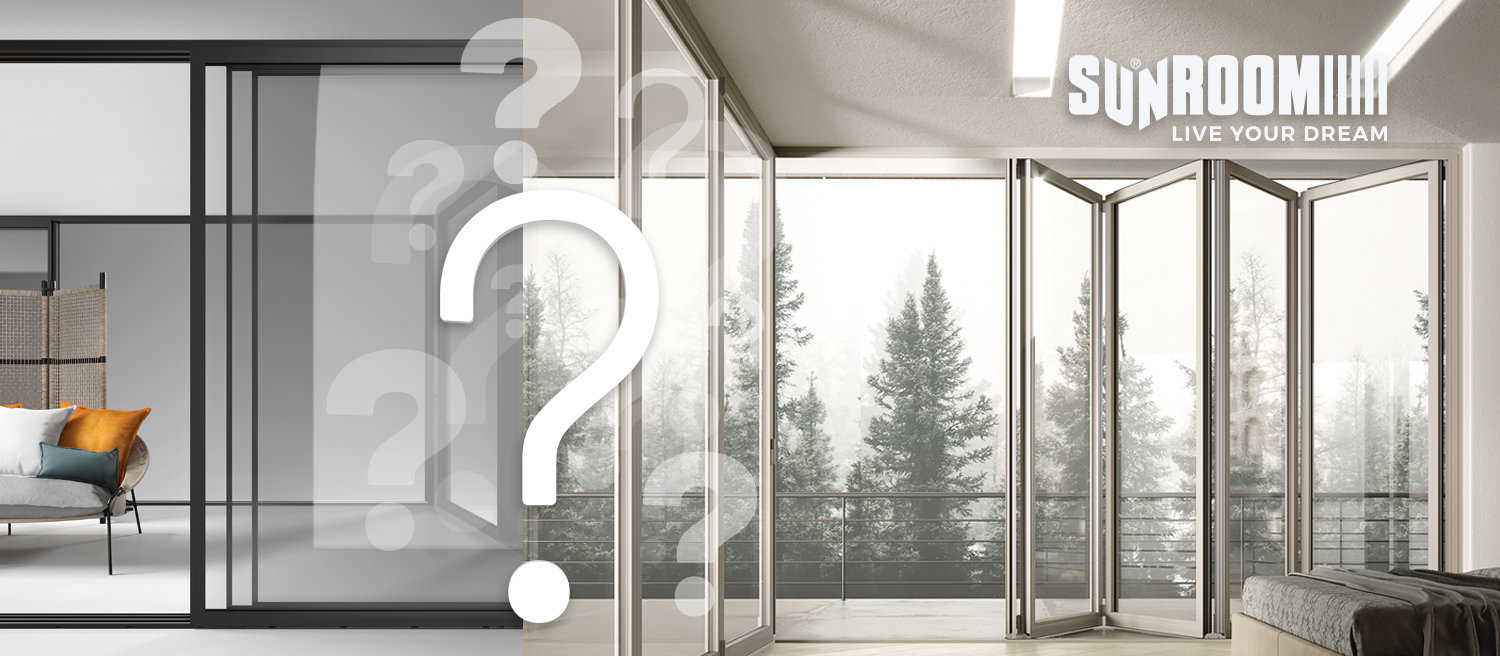
In the context of the “Energy Performance of Buildings Directive” (EPBD), the choice of a glass closure system is no longer a mere aesthetic detail, but a structural decision that directly impacts the overall thermal transmittance of the building and, consequently, its energy class.
To understand how to increase a property’s value, it is important to understand the differences between folding systems (stackable) and sliding systems: two technologies designed to meet diametrically opposite architectural needs.
Folding Systems: dissolving physical boundaries
Sunroom folding glass walls, such as the S.60 TT and S.75 TT models, are designed to ensure an almost total opening of up to 95%.
Thanks to a lateral accordion-style stacking system, the space occupied by the gathered panels is reduced to approximately 10% of the total length, eliminating every visual and physical barrier between indoor and outdoor spaces.
This technology is ideal for those seeking absolute flexibility. On a 5-meter opening, the stacked panels occupy only 50 cm.
In addition to flexibility, there is top-tier engineering solidity. Unlike budget solutions, Sunroom transfers all the weight onto the lower track, avoiding structural bending of the ceiling and ensuring constant smoothness of movement over time.
Thermal performance is also significant. The S.75 TT model achieves Uw transmittance values as low as 1.0 W/m²K, making it suitable even for the harshest climates.
Sliding Systems: large dimensions and total brightness
If the goal is to maximize the view even when the glass is closed, sliding systems are the preferred choice. Sunroom technology allows for exceptionally large panels, covering architectural spans exceeding 6 meters.
The S.150 TT system is an industry benchmark characterized by:
- Minimalist Design: The central meeting stile of just 26 mm offers an almost uninterrupted view.
- Load Capacity: Reinforced stainless steel rollers are designed to support panels up to 400 kg, allowing for the installation of high-performance low-emissivity triple glazing.
- Acoustic Insulation: A certified 44 dB, an extraordinary and essential figure for comfort in high-traffic urban environments.
Robustness, maintenance, and safety
The durability of a glass wall depends on the quality of its invisible components.
Sunroom chooses total quality and reliability: only stainless steel rollers and tracks are used, with treatments that make them particularly resistant even to salt corrosion.
A fundamental feature in projects such as the outdoor area of Ristorante Sopravento in Cattolica.
Our systems are certified up to Class B3 for wind resistance, ensuring structural integrity with gusts up to 160 km/h. Furthermore, the use of low-threshold tracks (only 21-23 mm), which can be recessed into the floor, ensures complete safety and total accessibility, complying with regulations on the removal of architectural barriers.
